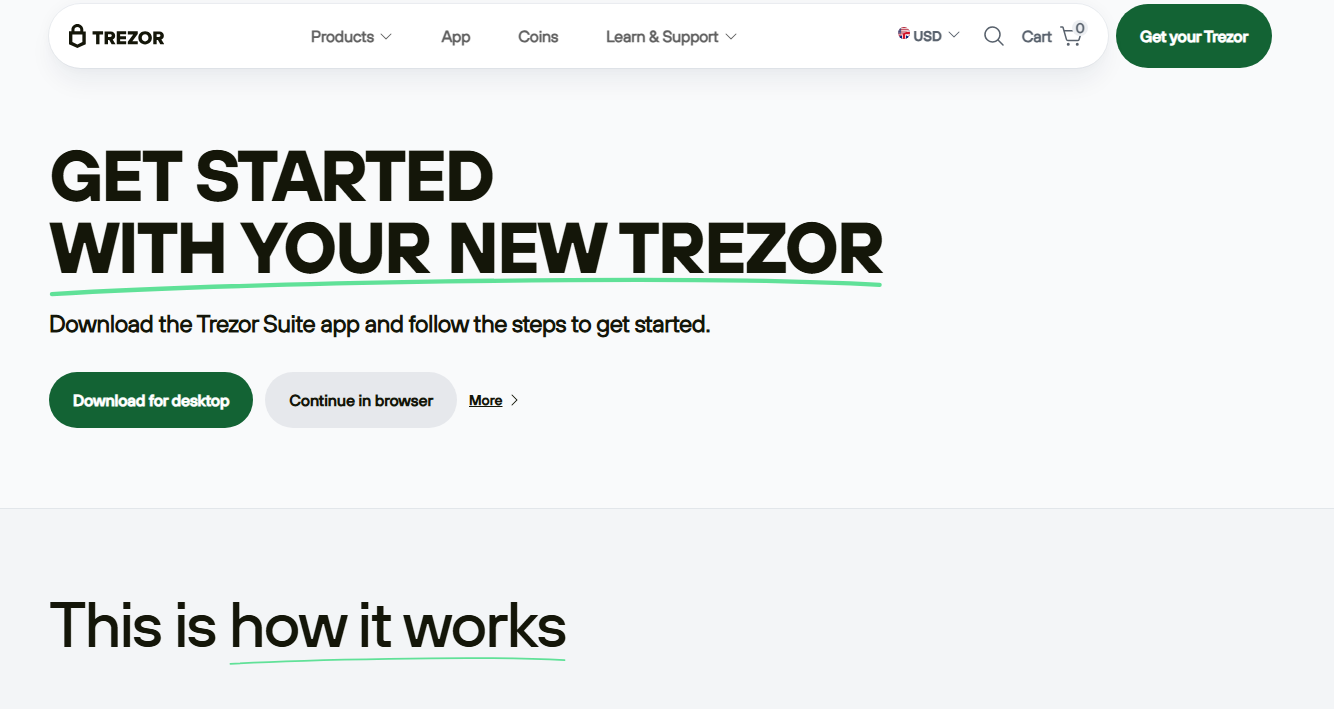
Trezor Suite — the secure desktop & web wallet that pairs with your hardware
A complete, approachable guide that takes you from the first connection to advanced privacy options — explained for curious learners and careful users. Includes practical explanations about blockchain concepts, private key custody, seed phrase hygiene, staking, DeFi integrations, and cold storage philosophy.
Quick overview
Trezor Suite is the official application for interacting with Trezor hardware wallets. Its role is simple but powerful: present readable blockchain information, prepare transactions, and let the hardware device perform sensitive cryptographic operations securely. The Suite is intentionally designed so the private key never leaves the device — a core idea in self-custody: you control the keys, you control the funds.
Blockchain
A public ledger of transactions — Trezor Suite reads this data to show balances and history.
Private key
The secret used to sign transactions — always stays inside the Trezor device when using Suite.
Seed phrase
Your recovery backup — usually 12–24 words — keep it offline and protected at all times.
A simple learning path (no transactions required)
1 — Connect & explore
Plug in your Trezor and open Suite to observe public addresses and historical transactions.
2 — Learn the UI
Familiarize yourself with portfolio view, account naming, and how Suite displays confirmations.
3 — Study signing prompts
Watch how Suite prepares a transaction and how the Trezor device shows the final details for signing.
How Trezor Suite protects your keys
The Suite never stores your private keys. Instead, it serves as a graphical interface: it fetches public blockchain data, prepares transaction payloads, and asks the connected Trezor device to sign them. Signing happens in the device's secure environment (a specialized chip) and the signed transaction is returned to Suite for broadcasting. This separation — sometimes called air-gapped signing in its strictest form — dramatically reduces the attack surface compared to software-only wallets. It’s the same core safety idea behind cold storage: keep the ultimate secrets offline and use a safe, auditable UI to interact with them.
Trezor Suite vs. Typical Mobile Wallet (conceptual)
Feature
Trezor Suite
Mobile Wallet
Key storage
Hardware device (cold)
Software on phone (hot)
Privacy controls
Advanced (coin control, Tor)
Limited (depends on app)
Best use
Secure custody & management
Convenience & daily use
Notable Suite features (what you’ll use)
Portfolio view
At-a-glance balances, historical charts, and multi-account aggregation for clear context.
Transaction verification
Detailed destination address and amount shown on-device for human verification before signing.
Privacy tools
Coin control and optional routing through privacy networks reduce address linkability.
Multi-coin support
Native support for major coins plus expanding token coverage through integrations.
A short perspective
“Trezor Suite makes the invisible visible: it turns on-chain mechanics into readable, verifiable steps while keeping the true secrets locked safely inside the hardware.”
Staking, DeFi and integrations — what to know
Trezor Suite may surface optional integrations that let you interact with staking services or decentralized finance (DeFi) protocols. These are powerful tools but come with additional complexity and risk: network fees, validator or protocol risk, and differing liquidity characteristics. If you explore staking or DeFi through Suite, treat these as advanced steps — study the protocol mechanics, understand how rewards and lockups work, and always verify contract interactions on your device screen before approving.
Frequently asked questions
Does Trezor Suite store my private keys?
No. Keys remain on the hardware device; Suite only facilitates communication and displays public data.
Can I use Suite without a Trezor device?
You can view some public addresses in read-only mode, but signing transactions requires a connected device.
Is Suite open-source and auditable?
Yes. Trezor's software is open-source and available for community review and audits.
How does Suite help learners?
Its clear visuals, step confirmations, and readable transaction details make blockchain concepts easier to understand without requiring risky actions.
Practical safety checklist
1. Keep your seed phrase offline in a safe place (paper or metal), never a photo or cloud file.
2. Always verify transaction details on your Trezor device screen before approving.
3. Update firmware only using the official Suite prompts; avoid third-party downloads.
4. Use passphrases or hidden wallets only if you fully understand recovery complexity.
5. Treat integrations like staking and DeFi as advanced — research thoroughly before use.
Conclusion — Trezor Suite in perspective
Trezor Suite turns complex, on-chain activity into something you can read, verify, and control — while keeping the most critical secrets safely offline in your hardware device. Whether you’re learning about blockchain basics, protecting long-term holdings in cold storage, exploring staking, or cautiously interacting with DeFi, Suite provides a strong, transparent bridge between you and the decentralized world. Start by observing, reading confirmations carefully, and keeping your seed and device security at the center of every decision. That attention to detail is what turns curiosity into confident, secure ownership.
Educational content only — not financial advice. Always follow official Trezor guidance for device operations and recovery procedures.